


Leading Marketing in a Digital and AI World
September 24, 2026
0 Comment


Why the future belongs to Marketing Directors who combine technology with human judgement
For more than three decades, the internet has transformed marketing. Websites, search engines, smartphones, e-commerce, social media, and cloud computing have fundamentally changed how organisations attract, serve, and retain customers.
Today, another transformation is underway.
Artificial intelligence is rapidly becoming part of everyday business life. It is writing copy, creating images, analysing data, recommending products, answering customer enquiries, and helping managers make decisions. Yet while the technology is changing rapidly, the purpose of marketing has not changed.
Marketing still exists to understand customers better than competitors, build distinctive brands, and generate sustainable, profitable growth, and create value.
The challenge for today’s Marketing Director is therefore not simply adopting AI, but understanding where technology creates advantage, where it creates risk, and where human judgement becomes more valuable than ever.
The more AI can do, the more valuable human judgement becomes.
AI has fundamental implications for what Marketing Directors spend their time doing — and what they should they become better at.
The first digital revolution is over
The first phase of digital marketing focused largely on new channels.
Organisations built websites, invested in search engine optimisation, embraced e-commerce, experimented with social media, and developed increasingly sophisticated digital campaigns. Marketing became faster, more measurable, and more accountable.
These technologies are no longer new. They are now simply part of business.
To lead marketing in a digital and AI world today the challenge is different. Rather than asking, “Which channels should we use?”, Marketing Directors increasingly need to ask:
- How should AI influence our decisions?
- How should data help optimise customer experiences?
- Which technologies genuinely improve competitiveness?
- Where should humans remain firmly in control?
These are leadership questions rather than technical ones.
AI changes the tools, not the purpose of marketing
Much of the discussion surrounding AI focuses on automation and efficiency.
While these benefits are real, they are only part of the story.
The greatest opportunity lies in improving the quality and speed of decision-making.
AI can identify patterns within large volumes of customer data that people may never notice. It can help marketing teams work more productively, generate alternative creative ideas, and pressure-test different scenarios. However, AI has no commercial judgement. It cannot fully understand organisational politics, people, long-term brand reputation, ethics, customer emotions, or strategic priorities. Those remain human responsibilities. Rather than replacing Marketing Directors and CMOs, AI is increasing the importance of leadership.
Technology evolves. Marketing evolves. Leadership matters most
The evolution of marketing leadership can be visualised simply:
Figure 1: The Evolution of Marketing Leadership
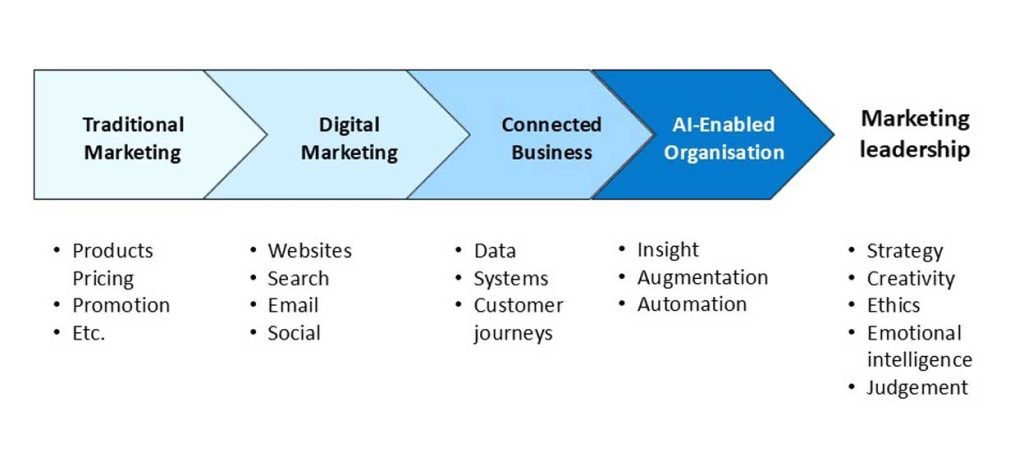
Each stage has expanded marketing’s capability. None has reduced the need for leadership. Indeed, the opposite is true. As technology becomes more powerful, organisations need stronger leadership to ensure it is applied responsibly, commercially and in ways that strengthen customer relationships.
Brand building has never been more important
One misconception is that AI will reduce the importance of brands. In reality, it is likely to increase it. As AI systems generate more content, products and recommendations, customers will increasingly seek organisations they know, recognise and trust. Brands communicate reliability, values, and expectations. They reduce uncertainty.
Creating a great customer experience has always been essential. The next challenge is creating distinctive customer experiences that customers remember, recommend and return to.
While technology can help deliver experiences, only organisations can create meaning.
Thus, marketing remains a people business
Perhaps the greatest surprise of the AI era is that emotional intelligence may become even more valuable.
As our recent FTSE 100 research found, Marketing Directors must increasingly work across organisational boundaries, and bring together sales, finance, operations, technology, and customer service in order to improve customer experiences.
Successful leaders build trust. They communicate clearly. They involve and inspire colleagues to solve problems rather than dictate solutions. Technology can accelerate decisions, but people determine whether to accept and implement or reject decisions and thus succeed or not.
Looking to the future
No-one knows precisely how marketing will evolve over the next decade. New platforms will emerge. Search behaviour will continue to change. AI capabilities will become increasingly sophisticated. Customer expectations will continue to rise.
Rather than trying to predict every development, successful Marketing Directors must develop what we describe as early warning radar—to continually scan the market, competitors, customers, and emerging technologies to identify opportunities and threats before others do.
So, remain curious. Challenge assumptions. Test new ideas while remaining grounded in sound marketing principles.
The organisations that succeed are unlikely to be those with the most technology. They will be those that combine technology with better judgement.
What AI cannot do – and what remains the role of the Marketing Director
As AI and digital technologies take on more of the technical and executional work of marketing, some distinctly human capabilities become more—not less—important.
AI doesn’t make all human skills more valuable. It makes particular human capabilities more important where the job is to decide, interpret, challenge, create meaning and influence people. So you need to:
1. Judge what is creatively good
The more AI can do, the more valuable human judgement becomes.
AI can generate huge volumes of copy, images, concepts and campaign ideas. However, generating possibilities isn’t the same as knowing which idea is distinctive, relevant to the customer and right for the brand.
The Marketing Director therefore needs to be able to brief creativity well, challenge it constructively and recognise genuinely strong creative work. Taste, judgement, imagination and the ability to make connections remain human responsibilities.
Your job is to decide:
- Is the idea genuinely distinctive?
- Is it relevant to the customer?
- Does it strengthen the brand?
- Will people notice and remember it?
- Is it commercially worthwhile?
- Is it appropriate for the organisation?
So don’t outsource your creative judgement to AI. But do use AI to increase the number of possibilities you consider — then apply human judgement to choose which is best.
2. Build brands that people actually value
AI can help analyse brand performance and create brand assets. It cannot, by itself, cannot determine the underlying reason why customers prefer a brand. Nor can it decide what a brand should stand for, why customers should care, or how a distinctive position should translate into the experience people actually value.
The marketing leader therefore still needs to understand customers deeply, make difficult choices about positioning and differentiation, and ensure that brand promise and customer experience reinforce one another.
That makes brand judgement a human leadership capability rather than simply another technical marketing task.
3. Understand customers beyond what the data says
AI will make organisations awash with more data, faster. But more data doesn’t automatically produce more insight.
New technology makes it easier to collect, analyse and act on customer data. But customer intent and historic data isn’t the same thing as understanding customer behaviour, and data doesn’t automatically explain why people choose, reject, trust or recommend something.
AI can tell you what customers did. Marketing Directors still need to work out why — and what it means.
So this requires curiosity and empathy: the ability to observe and get close to customers, interpret evidence, ask better questions, understand emotional as well as functional benefits, and recognise what the numbers may not be telling you.
It also requires commercial understanding and the willingness to challenge prevailing views.
And sometimes the most important insight will be something not yet contained in the data.
4. Know when to challenge the machine
The more easily AI can produce an answer, the more important it becomes to ask:
Is this actually right?
AI literacy isn’t the ability to use ChatGPT. It is the ability to know when not to believe it.
The modern Marketing Director needs enough understanding of AI to know:
- what it can and cannot reliably do
- what assumptions it is making
- whether the data or source material is sound
- whether the answer makes commercial sense
- whether it introduces brand, reputational, legal or customer risks
- when human review is essential.
Marketing leaders need to judge the quality, provenance, relevance and consequences of AI-generated output; challenge assumptions; recognise hallucination or bias; protect brand integrity and customer trust; and understand when human expertise must override the machine. So build machine and human stress-testing into your processes.
5. Influence people who do not report to you
If marketing expertise is increasingly distributed across the CEO, Board, customer, commercial, technology and other leadership roles, the Marketing Director cannot simply rely on organisational ownership of marketing to provide influence.
You have to earn it.
You need to explain, influence, manage and lead — our seven essentials — and translate customer and marketing insight into language that the CFO, CIO, CEO, sales leader and Board can act upon.
That means building trust across functions, resolving competing priorities and persuading people who do not report to you.
The Marketing Director increasingly needs to influence the CFO on investment, the CIO on technology, the sales director on customers, the CEO on growth and the Board on risk and opportunity.
That means being able to explain complex things simply, understand other people’s priorities and make a compelling commercial case.
AI can give you information. It cannot build the trust required to persuade the Board to act on it.
6. Decide what matters
Moving forward, Marketing Directors will have more possibilities, more channels, more content, more data, more automation and more AI-generated recommendations than ever before.
The scarce resource becomes attention and prioritisation.
So, to lead marketing in a digital and AI world, the Marketing Director’s job is increasingly to decide what not to do as well as what to do.
- Which customers matter most?
- Which opportunities deserve investment?
- Which data is useful?
- Which AI applications are worth implementing?
- Which channels are distractions?
- Which brand initiatives strengthen the proposition?
- Which projects should stop?
The Marketing Director’s New Advantage
AI will make many marketing tasks faster, cheaper and easier. That doesn’t make the Marketing Director less important. It changes what they are expected to contribute.
The paradox of AI is that as machines become better at doing marketing tasks, human judgement becomes more important in deciding what should be done, and how it should be done.
Competitive advantage will increasingly come from the ability to interpret rather than simply analyse; judge rather than simply generate; understand people rather than simply track behaviour; build brands rather than simply produce content; and influence the organisation rather than simply manage the marketing function.
The future Marketing Director therefore needs to be neither an AI technologist nor a traditional brand manager. They need to be a commercially minded business leader who can combine customer understanding, creativity, brand judgement, data, technology and human influence.
In other words, the Marketing Director’s value is moving further upstream — from doing marketing to deciding what marketing should do, why it should do it and how it should create value for customers and the business.
A practical guide for today’s Marketing Director
The latest edition of The Marketing Director’s Handbook is an in-depth guide to lead marketing in digital and AI world.
Volume 3 – Leading Marketing in a Digital and AI World examines how AI, digital transformation, data, platforms, governance, and leadership are reshaping the Marketing Director’s role. It will help you ask better questions, shape better strategies, and influence and lead wisely across your organisation. It is out now.
For readers seeking a comprehensive marketing guide, our new combined Volumes 1 & 3 edition brings together the enduring principles of marketing strategy and leadership with the latest thinking on digital marketing and artificial intelligence.
Whether you are an experienced Marketing Director, an aspiring CMO, a business leader or a senior marketer preparing for your next role, the fundamentals remain the same.
Technology will continue to evolve.
Marketing will continue to evolve.
The need for thoughtful, commercially-minded marketing leadership has never been greater. So, the future is yours to influence and shape.
The Changing Influence of Marketing in FTSE 100 Companies: Marketing Leadership Benchmark
September 18, 2026

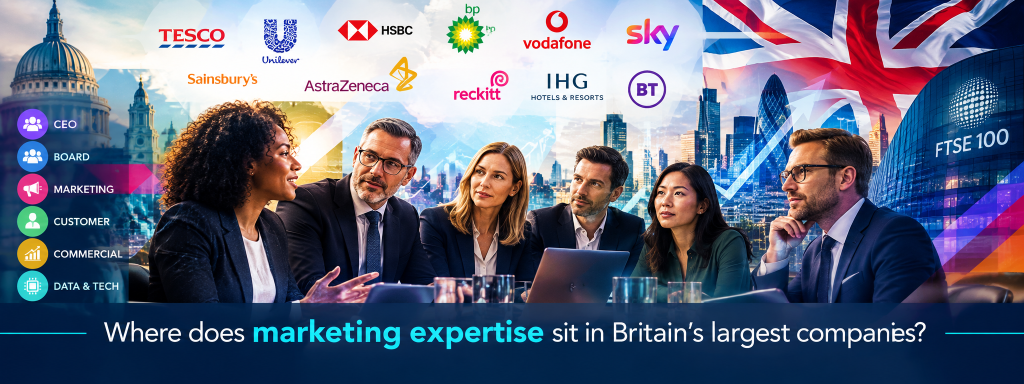
New research by The Marketing Directors to accompany the publication of the latest edition of The Marketing Directors’ Handbook finds that 70% of FTSE 100 companies have meaningful marketing, customer or brand expertise at Board or senior-management level. Within the FTSE 100 companies:
- 0% have a conventional Marketing Director on the main PLC Board
- 11% have a CEO with substantial marketing/customer expertise
- 45% FTSE 100 Boards have substantial marketing expertise beyond the CEO
- 30% have a marketing leader beyond the Board i.e. on the senior management teams
- 38% have additional substantial marketing expertise on the senior management team
- So overall 70% have marketing expertise at Board or senior-management level
Background and Research Objectives
In 2007, Professor Malcolm McDonald conducted research that concluded that just 14 FTSE 100 companies had marketing directors on their Boards. This was widely commented on and perceived at the time to diminish the role and influence of marketing as a profession. We commented on this in Volume 1 of The Marketing Director’s Handbook. So we’ve now researched Britain’s FTSE 100 companies, to answer the question today: where does marketing expertise sit within the leadership of the business, and how far does it influence corporate decision-making?
Six Headline Findings
1. Marketing expertise is everywhere — but the traditional Board Marketing Director has disappeared
The strongest finding from the research is that 70 of the 100 FTSE companies have meaningful marketing, customer or brand expertise either at PLC Board or senior-management level.
The research identifies three overlapping forms of senior marketing influence:
- marketing/customer experience within the PLC Board;
- a senior executive whose principal role is marketing or an equivalent substantial marketing function;
- other senior executives with meaningful marketing, customer or brand expertise.
The picture is that marketing capability is not necessarily concentrated in a single “Marketing Director” but can be distributed between the CEO, Board, Chief Marketing Officer/Chief Customer Officer/Chief Growth Officer and other senior commercial or business leaders.
2. Zero Marketing Directors sit on FTSE 100 PLC Boards
Our analysis identifies 0 of 100 current FTSE 100 companies with a Marketing Director, CMO or equivalent whose formal role places them on the main PLC Board. This contrasts with the 14/100 reported by Professor Malcolm McDonald’s in 2007 (1).
The comparison is striking — and raises the question — why?
The answer lies partly in how corporate leadership has changed.
The statutory Board is no longer a complete map of corporate influence.
The marketing leadership function has not disappeared; it has increasingly moved into broader executive and commercial roles.
3. Marketing experience reaches the CEO
Our research identifies 11 CEOs with substantial marketing, consumer, customer or marketing-led commercial backgrounds.
Some modern CEOs started in marketing, brand, customer or commercial roles and subsequently accumulated broader operational and financial responsibilities. Marketing expertise has therefore become part of a broader general-management skillset.
The routes are diverse. At Tesco, CEO Ken Murphy’s career includes substantial commercial, marketing and brand experience, including global product brand management. Reckitt’s, CEO Kris Licht previously served as President, Health and Chief Customer Officer. At Burberry, CEO Joshua Schulman’s career spans senior brand, merchandising, luxury retail and chief executive roles.
This is significant because it demonstrates that marketing expertise can be a career route to general management and ultimately the chief executive role.
4. Customer-led businesses are the strongest adopters of marketing leadership
The sector analysis is perhaps the strongest corroborating evidence for the overall finding.
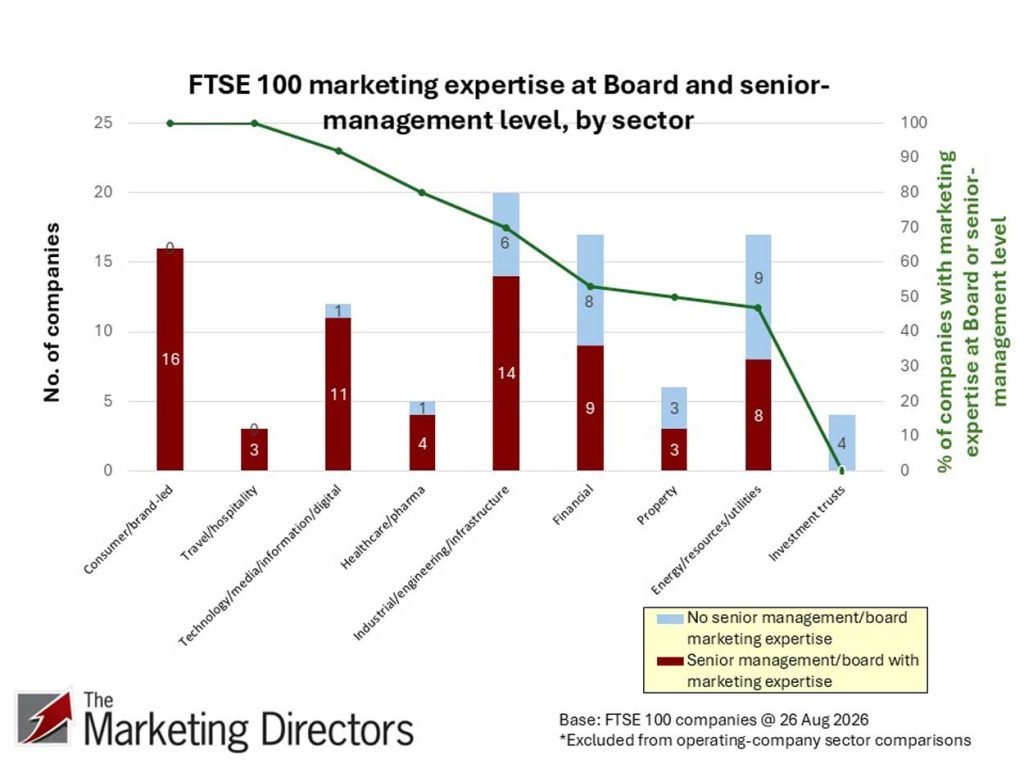
The FTSE100 comprises 16 companies classified as consumer/brand-led. 16 (100%) have senior-management marketing/customer expertise; 15 (94%) have Board-level marketing/customer expertise; and 100% have expertise at one or other level. This is an unusually strong concentration.
The result is intuitively credible: in businesses where brands, consumer choice, customer experience, loyalty, pricing, product proposition and competitive differentiation are fundamental business drivers, marketing capability is much more significantly represented within senior leadership.
The travel/hospitality and technology/media/information/digital sectors show a similarly high incidence of senior-management expertise.
At the other end of the spectrum, the incidence is substantially lower in sectors such as energy/resources and financial services.
Marketing leadership is most deeply embedded where customers, brands and competitive differentiation are most central to the business model.
Figure 1: FTSE 100 marketing expertise at Board and senior management level, by sector
5. The Marketing Director is becoming a broader business leader
Our research also identifies over 30 more senior-management marketing leaders operating outside of the Board.
Some have familiar titles: Chief Marketing Officer, Marketing Director, and Chief Customer & Marketing Officer.
Others operate under broader titles incorporating: customer, commercial, growth, data, markets, technology and corporate affairs.
At Sainsbury’s, Mark Given combines technology, marketing and data leadership on the Operating Board. Also at Aviva, Cheryl Toner combines customer and marketing leadership at Group Executive Committee level. While at IHG, the Chief Commercial & Marketing Officer sits on the Executive Committee.
This reveals the changing nature of the discipline. Marketing appears increasingly embedded in broader commercial and customer leadership rather than always operating as a discrete or siloed corporate function.
6. Why has the traditional Board Marketing Director disappeared?
There is no single explanation, and our research does not establish a direct causal link. However, the structure and responsibilities of corporate leadership have changed substantially since 2007.
Boards and management have become more clearly differentiated
The UK Corporate Governance Code now distinguishes the Board’s governance and oversight responsibilities from the management of the business. The FRC’s current guidance emphasises that Boards should determine matters reserved to them while obtaining the information, expertise and advice needed to make effective decisions. The 2024 Code applies from financial years beginning 1 January 2025, with the new Provision 29 applying from 1 January 2026.
Thus a senior executive does not need to be a statutory director to have substantial influence over corporate strategy and performance.
Executive leadership has become an important layer between the Board and the business
Our research found a recognisable Executive, Management or Operating Board — or equivalent — in 86% of companies.
This is where many of today’s senior functional leaders sit.
A CMO, Chief Customer Officer or Chief Growth Officer can therefore have significant responsibility for strategy, investment, customer experience, brand and commercial performance without being a statutory director of the PLC.
The Board’s responsibilities have also broadened
Under Section 172 of the Companies Act 2006, directors must promote the success of the company while having regard to, among other things, long-term consequences, relationships with customers and suppliers, and the company’s reputation.
This means that issues traditionally associated with marketing — customers, relationships, reputation and long-term value — sit within the wider context of Board decision-making.
Thus, there is no requirement per se to give marketing a statutory role on the Board.
Reporting and governance have become more explicit
Large companies have also had to explain, through Section 172 reporting, how directors consider these factors in their decision-making.
Taken together, these developments help explain why the absence of a specialist Marketing Director from the statutory Board does not necessarily indicate the absence of marketing influence.
Conclusions
The traditional Board Marketing Director may have disappeared, but marketing itself has not. What appears to have changed is where marketing expertise sits — increasingly distributed across CEOs, PLC Boards and senior executive management.
In 2007, the presence of a Marketing Director on the PLC Board was an important indicator of marketing’s corporate standing. In 2026, that single measure tells only part of the story.
The evidence suggests that marketing has evolved from a discrete corporate function into a more widely distributed business capability.
The challenge for today’s Marketing Director is therefore not simply to gain a seat at the table, but to demonstrate the customer, commercial, technological and strategic capability to influence the decisions being made around it.
“Three decades ago, marketing was often viewed primarily as a creative or promotional department, and its contribution to business value was frequently misunderstood and under-appreciated. Our experience is that increasing competition and digital disruption have changed that. As markets and products become more commoditised, the ability to understand customer intent, use data and technology intelligently, build distinctive customer experiences and drive growth has made marketing capability increasingly important at executive level.”
“The modern Marketing Director is no longer simply a brand steward. They need to be a commercially minded business leader who can connect customer understanding, marketing expertise, technology and data to business performance.”
Guy Tomlinson, co-author of The Marketing Director’s Handbook
“There is a growing body of research into the relationship between marketing experience at Board level and business performance. We would expect the influence of marketing expertise to extend further as businesses and sectors become more competitive.”
“That is particularly relevant in B2B markets, where marketing has sometimes been less prominent than in consumer-facing businesses. Companies operating with strong sales functions, for example, can add significant value by bringing marketing skills into the wider commercial organisation — developing a deeper understanding of customer needs, markets and demand rather than relying on sales activity alone.”
Tim Arnold, co-author of The Marketing Director’s Handbook
Reference
- McDonald, M. Professor (2007) Marketing on the Boards of FTSE Companies (researched using Companies House information), Cranfield School of Management (variously cited, though no longer available online)
Further information
The numbers behind the findings (PDF download)
The 2026 FTSE 100 results, definitions and headline comparisons.
Research methodology and evidence (PDF download)
How companies were classified, sources used, limitations and historical methodology
Download the full 2026 FTSE 100 Marketing Leadership Benchmark (PDF)
Full research, numbers and methods on the changing influence of marketing in Britain’s largest companies
If you have questions on our methodology or findings just get in touch.
The Role of Marketing: How Marketing Drives Growth, Builds Value and Creates Competitive Advantage
June 05, 2026


The role of marketing is to understand customers, create value and drive profitable growth by shaping strategies, guiding innovation and aligning the organisation around customers and their needs. Research from McKinsey, Deloitte, Gartner, the IPA and others consistently shows that organisations with strong marketing capability grow faster, innovate more successfully and also outperform competitors over time.
Why Marketing Matters More Than Ever
Marketing has never been more important to business success. In a world of rapid technological change, rising customer expectations and intense competition, marketing is no longer a communications function — it is the engine of organisational growth.
This article explains the true role of marketing, backed by evidence, and outlines how strengthening marketing capability can transform business performance.
What is the Role of Marketing? (Definition)
Marketing’s role is to understand customer needs, shape strategy, guide innovation and drive profitable growth by creating, communicating and delivering value.
The 7 Seven Core Roles of Marketing in Modern Organisations
1. Customer Insight & Understanding
Marketing identifies customer needs, behaviours, motivations and pain points. This insight informs marketing strategy, innovation, brand development and also customer experience.
Why it matters:
- Customer–centric companies are 60% more profitable (Deloitte) (1).
- Organisations that deeply understand customers innovate more successfully (Harvard Business Review) (2).
2. Market Strategy & Positioning
Marketing defines where to play and how to win — through segmentation, targeting, positioning and value proposition design.
Why it matters: Clear positioning improves differentiation, pricing power and long–term growth (McKinsey)(3).
3. Product & Service Innovation
Marketing shapes propositions based on customer insight, ensuring products and services meet real needs.
Why it matters: Companies that integrate marketing early in product development outperform those that do not (1).
4. Brand Building & Reputation Management
Marketing builds trust, distinctiveness and long–term brand equity — proven to drive profitable growth.
Why it matters: Long–term brand building delivers the highest ROI Ehrenberg–Bass Institute (4) and IPA (5).
5. Demand Generation & Sales Enablement
Marketing creates demand through integrated campaigns, digital channels, content and sales support.
Why it matters: High–performing organisations combine creativity, analytics and purpose — and grow 2.3x faster (McKinsey) (6).
6. Customer Experience & Retention
Marketing ensures consistent, valuable experiences across the customer journey, improving loyalty and lifetime value.
Why it matters: Customer experience is now a key driver of revenue and retention (Forrester) (7).
7. Performance Measurement & Growth Optimisation
Marketing uses data, analytics and experimentation to improve effectiveness and ROI.
Why it matters: Data–driven organisations outperform competitors and allocate budgets more effectively (Gartner)(8).
Why Marketing Matters: Evidence That Marketing Drives Growth
Across industries, research consistently shows that the role of marketing is as a primary driver of growth:
1. Marketing-led companies grow faster
McKinsey finds that companies that combine creativity, analytics and purpose grow revenue 2.3x faster than peers. Marketing is central to this “triple play”, driving customer understanding, innovation and brand strength (3).
2. Customer centric organisations are more profitable
Deloitte reports that customer–centric companies are 60% more profitable (1).
3. Brand building delivers the highest long–term ROI
IPA research shows that long–term brand investment outperforms short–term activation (5).
4. Customer experience drives loyalty and revenue
Forrester finds that improving CX increases loyalty, reduces churn and boosts revenue (7).
5. Distinctive brand assets drive market share
Ehrenberg–Bass research shows that distinctive brand assets increase mental availability and growth (4).
6. Marketing drives innovation success
The Harvard Business Review highlights that marketing–led innovation is more likely to succeed (2).
Together, this evidence demonstrates that marketing is not a cost centre — it is a growth engine.
The Strategic Role of Marketing in Business Success
Marketing is a strategic capability that shapes business success. Organisations with strong marketing functions:
- Grow faster
- Innovate more effectively
- Build stronger brands
- Create more loyal customers
- Outperform competitors over time
Marketing aligns organisations around customer value — the most reliable route to sustainable growth.
Insights from The Marketing Director’s Handbook
Drawing on our own work and research for The Marketing Director’s Handbook, several themes emerge:
- Organisations with strong marketing capability consistently outperform their peers.
- Marketing’s influence increases during periods of uncertainty, when customer understanding becomes critical.
- Many organisations under–invest in marketing capability, limiting growth potential.
- Only a minority of FTSE 100 companies have marketing represented at board level — yet those that do tend to outperform.
These insights reflect decades of hands–on experience working with CEOs, CMOs and leadership teams.
Examples of Marketing’s Impact (Client Success Stories)
1. Consumer Brand Strategy and Innovation
Researching consumers and developing a new communication campaign helped drive a nine-fold sales increase for a product in overlooked consumer markets.
2. Professional Services Repositioning and Communication
Researching and creating a new proposition and communications for a professional educational qualification inspired real growth in students across seven international markets
3. Childrens’ Brand and Marketing Strategy Development
Working collaboratively, engaging consumers and investing in professional marketing inspired a new brand positioning and marketing strategy. As a result this led to a trebling of theatre schools and sales.
If you want to strengthen your organisation’s marketing capability or clarify the role of marketing in your business, we can help. We work with leadership teams to build marketing functions that drive growth, innovation and customer value. So explore our marketing consultancy services or get in touch for an informal conversation.
Frequently Asked Questions (FAQs)
What is the role of marketing in business?
To understand customers, create value and drive profitable growth. The role of marketing includes:
Understanding customers
Shaping strategy
Guiding innovation
Building brands
Creating demand
Improving customer experience
Measuring and optimising performance
Why is marketing important for business success?
Because it shapes strategy, guides innovation, builds brands and drives demand.
What are the strategic functions of marketing?
Insight, strategy, innovation, brand building, demand generation, customer experience and performance measurement.
How does marketing drive growth?
By aligning the organisation around the customer and creating demand for products and services
What is the difference between marketing and sales?
Marketing creates demand and shapes strategy; sales converts demand into revenue.
References
These sources provide independent evidence of marketing’s impact on business performance.
(1) Deloitte – Customer Centricity Report: https://www2.deloitte.com
(2) Harvard Business Review – Marketing’s Role in Innovation: https://hbr.org
(3) McKinsey – The New Marketing Organisation: https://www.mckinsey.com/capabilities/growth-marketing-and-sales/our-insights/were-all-marketers-now
(4) Ehrenberg–Bass Institute – Distinctive Brand Assets: https://www.marketingscience.info
(5) IPA – The Long and the Short of It (Binet & Field): https://ipa.co.uk
(6) McKinsey – The Growth Triple Play: https://www.mckinsey.com/capabilities/growth-marketing-and-sales/our-insights/the-growth-triple-play
(7) Forrester CX Index: https://www.forrester.com
(8) Gartner CMO Spend Survey: https://www.gartner.com/en/marketing/research/cmo-spend-survey
Key Takeaways
- The role of marketing is to understand customer needs, drive innovation, and create value for profitable growth.
- Strong marketing capabilities help organisations grow faster and improve brand equity over time.
- Seven core roles include customer insight, market strategy, product innovation, brand building, demand generation, customer experience, and performance measurement.
- Evidence shows that customer-centric companies are 60% more profitable and that marketing drives innovation success.
- Effective marketing aligns organisations around customer value, leading to sustainable growth and superior business performance.
How to Grow your Business? 7 Tips for Successful Business Growth
March 01, 2023

It seems that world economies follow a never ending series of boom and bust. Just when we thought global economies stable and productivity improving along come new challenges. First Covid-19 (2020), and then the Russian invasion of Ukraine (2022), and all that goes with it, including the rise of energy and food prices. However, when dealing with tough times, and particularly recession, if you face declining or flat sales, how do you grow your business? So do you plan cautiously or aggressively? In all situations marketers have a key role to play and you have a choice to view your glass as half-full or half-empty. Here are seven pointers to successful business growth:
1. Be more vigilant to threats and opportunities
Information is a source of competitive advantage. While tough times present threats, they also present opportunities – a lower cost investment opportunity here, or opportunity to take out a competitor there. Rarely will there be greater opportunities for a smart marketing and research department to prove its worth. So understand changing market forces and customer needs and provide timely intelligence and quality thinking to spot new opportunities. There are many ways to do this. Firstly, empower your sales team to fact-find, talk to, or research customers. Also track media activity on trends and what your competitors are doing; read investment blogs and company reports too. Then take this intelligence, and use scenario planning to think through how markets might evolve, and devise strategies to survive or thrive in each circumstance. This is something most successfully undertaken by Shell to address turbulent oil prices.
2. Ensure your business fundamentals are sound
The most successful businesses are those that are the most customer or audience driven. So if tough times impede your sales, this most likely indicates a weakness in your offer which needs to be fully understood and addressed. So first check your market share, and if that has fallen too, it suggests you need to do more to compete. However, whatever the economic situation, clear insights must inform what you do. Your startpoint is to ensure a strong product offer. Then with a sound marketing strategy in place you’ll be in a good position to invest and grow.
3. Reassess your product and brand portfolio
A consequence of the present inflationary times, is that mortgage costs are rising, and so are savings rates. But these changes affect people differently. Those with their disposable income under pressure will behave differently to those who are ‘flush’. For example, they will be more motivated to save money (energy) by switching lights off and perhaps going to bed earlier. Whereas those who are more flush may be more willing to invest for the longer term, by investing in low-energy lighting or extra home insulation.
Fast moving consumer goods are typically the first markets to experience change in buying behaviour. Those under financial pressure may shop around more, switch to cheaper outlets, and buy own label products instead of brands. Those who are more ‘flush’ may pay more to feel better.
The purpose of this discussion is not to predict behaviour but merely to spotlight the ease and speed with it changes. Your challenge is therefore to anticipate and understand change, and react quickly.
4. Maximise cash
The trigger for business closure is usually lack of cash. As evidenced by the recent administration of much lauded battery manufacturer, British Volt which has just been bought out by new Australian owners. Of course, cash management is the responsibility of all, but as this is a marketing blog, let’s focus on what marketers can do. One opportunity is to devise strategies to bring forward and maximise cash flows, for example, by rewarding early payment. Another is to reduce marketing costs. So seek out more efficient ways to communicate. In a worst-case situation, devise ways to rationalise your team. View change as an opportunity to ‘right-size’. Consider what roles are ‘must’ and ‘nice-to-have’. Also, make sure that the right resources are in the right places and perhaps refresh the culture. This then provides a more robust foundation to on which to build, invest and probe for renewed growth.
5. Don’t stop promoting your products but do be smarter about how you do it
Some studies that show how the share of advertising voice correlates with market share. There is also evidence to suggest that those who invest in proactive marketing during tough times are the first to emerge from the tough times. Also that they emerge the strongest. So optimise and promote the benefits of your products, and use creativity to maximise those benefits. If you focus on building your brand you’ll help avoid creating a hostage to fortune.
6. Invest while advertising bargains abound
The media market is in a state of perennial flux. As the share of one declines, often does the cost per impression, rating point or click. So shop around for advertising bargains. Over the last two decades promotional spend has shifted to digital media, most notably, Google and Facebook. Often when data to justify return on investment has been sparse. However, their recent declines in advertising income suggests their bubble is bursting. As money shifted to digital, other mainstream media such as television and radio became relatively better value. New kids offering better value propositions such as TikTok have also joined the block too.
7. But manage the risks!
Of course there are risks. But think big, and cultivate a mindset of controlled aggression to mitigate the risks. So test, and test your way from low cost to higher cost business building initiatives. Though only when you are sure that investments work, and have the metrics to prove it, should you invest heavily.
Marketing Inspiration
- How to grow your business starts with good consumer understanding, and a good product. Then profitable product promotion.
- So build your business, product and brand strategies on facts by using robust market research. Also make sure you your have processes in place to identify opportunities and threats. Then you’ll be better equipped to, and more timely in making investment recommendations to your Board.
- Focus your resources on making sure your products are as fit and competitive as possible to compete in their niches. Because Darwinist fundamentals apply.
- Then, when promoting your products, carpe diem. Take a long and short term view on payback, but make sure you earn more than you spend. To do this, don’t just follow the herd, seek out lower cost marketing opportunities. In so doing you will be able to grow your business while others are worrying or sitting on their laurels.
For personal advice and support on how to grow your business just give us a call.
Business Survival; Understand the forces for change
February 17, 2021

The Covid-19 pandemic changed the lives of us all. And the consequences of the Russian invasion of Ukraine, and the Hamas attack on Israel also continue to rumble around the world. Many individuals and businesses are adversely affected through no fault of their own. But there is always more going on than first meets the eye. There are always a myriad of macro and micro forces that change customer behaviour, markets, and point to new opportunities as well as threats.
What are forces for change?
Sales of high heeled shoes fell dramatically during the pandemic (1) notwithstanding the staying at home, health and fashion memes that took hold. Car usage also declined without a need or opportunity to travel. And today, the sales mix of cars continues to change due to concerns about climate change, pollution and healthy living. In the UK, most notably, also due to legislation, extension of low emission areas and the associated cost drivers and barriers.

Pandemic magnification
Some shifts were magnified by the C-19 pandemic. And the biggest shift of all … to a digitally dominated world …. was also facilitated by smarter phones with increasing and lower access cost.
The shift is most obvious in retail (2). Whilst many retailers bemoaned the health crisis and gobbled up the Government grants, this merely diverted attention from their inability to anticipate and position themselves to compete in a digital world.
Identify or face the consequences of shifting markets
Consequences flow from the inflexibility of Marks and Spencer, to the ubiquity of Tesco, to the profit squeezing of fund-owned brands such as Boots and Debenhams. Also the fall from grace of wheeler dealers who grew fat on the glories of pre-existing brands. All were further compromised by greedy local government making it more difficult and costly to visit any high street.
Marketing Inspiration
To survive and thrive at all times, there is a need to remain vigilant to both macro and micro forces affecting your business. Then, and only when, you understand the forces, can you figure what these mean for your future. This is key to devising effective business and marketing strategies.
Every force has an opposite though not always equal reaction. For example, for many the balance of office and home working changed. This continues today suggesting it is a long-term behavioural shift. Underpinned by an individual’s ability to save travel costs. And also to boost business productivity. There is evidence of increased staff productivity, as well as well-being and health. Businesses participating in 4-day working week trials concur! (4) So on one hand, expect a further shift to 4-day from 5-day working weeks and all that that brings. And on the other, expect more incentives to entice staff into offices.
While 77% of UK CEOS have increased their investment in digital transformation (3), we suggest you work out the best balance and inter-relationship between on-line and offline. Certainly there are pitfalls in managing marketing in a digital world as we’ve warned for years. However, they are only coming to the fore as evidenced by recently announced layoffs by the likes of Meta. Though those of you with longer memories will remember the Internet boom and then bust of nineties. So tread carefully and measure and manage promotional effectiveness across all media.
A counter force, as confirmed by our recent Buckinghamshire High Street survey, is that High Street businesses must pay more attention to the customer experience to win custom back from online. Some places, of course, already do this, and the likes of John Lewis, and many garden centres, for example, have long realised the value of combined shopping and eating/ drinking experiences.
Governments and councils speed or impede change too. By enabling a fairer or laissez-faire playing field between the High Street and online pure plays. For example, by easing High Street access, parking, reforming property charges, and taxes, shifts demand and supply-side economics. All is fair-game for the lobbyist.
References
(1) Glossy.co (2020)
(2) A record 35% of sales were online (January 2021 – ONS)
(3) CEO survey (PricewaterhouseCoopers March 2021)
(4) 4-day working week trials (Feb 2023)
(5) Seven perks to entice staff into offices, BBC (March 2023)
Strategic Planning: The Power of a Marketing Mindset
January 04, 2021

We often get asked to help businesses get closer to customers and to develop new business, marketing and brand strategies. Yet businesses plan, organise and manage in different ways. Virtually all also have their own lexicons. Thus sometimes a challenge to address the latter really requires the former and vice versa.
However, a marketing mindset is powerful to address either, and indeed all of these challenges. Marketers are also increasingly empowered to lead business strategy, and many of the world’s most successful businesses are led by CEOs who previously held marketing functional skills.
However, marketing has not always been viewed as a strategic planning and management discipline. It only emerged formally as such in the 1950s (1). Marketing functions evolved from sales, and brand functions, from communications. However, customers and brands are the only constant in a fast-moving digital world.
Simplified strategic planning: 3 steps to success
So here is a simplified strategic planning process that is adaptable for all (2) (Figure 1 – Infographic). By understanding where a business or brand is now and where a business wants to be in the future allows you to plot a route from A to B.

Step 1: Clarify where the business or brand is now
The first step is to understand where the business or brand is now. So determine what are your current business, marketing and brand strengths and weaknesses and what drives growth and profitability?
The marketing discipline uniquely looks through the lens of customers and customer segments to assess issues, size market opportunities and demand influences. It also looks at competitive relativities. So the answer these questions looking through these lens. To do this most robustly, understand your own profitability where the profit opportunities are in the market.
Step 2: Use imagination and analysis to generate ideas, and determine where you want to be
Bring together your colleagues and use your combined imagination to envision your future (2). What does this look like? What would motivate your stakeholders? Then write a series of clear, challenging, and inspiring goals. While some organisations prefer an analytical approach to business strategy development, others prefer a more creative approach. However, there is merit in dual ‘left brain’ and ‘right brain’ thinking. Left brain thinking involves assessing the pros and cons of each idea or opportunity. Right brain thinking requires stepping away from the detail, and taking inspiration from the world around, to imagine new opportunities and destinations. In our experience no-one has a monopoly on good ideas, and employing different methods leads to better outcomes.
Planning from the customer, market and brand point of view requires considering how to establish or meet customer needs or change customer perceptions. As distinct from setting financial goals, say increasing sales by 5% or realising £Xm. The limitation with the latter is that it is not initially market and customer based. Though financials will need overlaying at a later date.
Step 3: Conduct gap analysis and figure how to bridge the gap
By clarifying where you are now and want to be, will allow you to quantify and qualify the size of the gap that needs bridging. In so doing, potential roadblocks or key issues to address should also become clear. So the challenge is then to design strategies – ‘how to’ solutions, to address the key issues. If this is not possible, then new goals need setting.
Strategic planning success factors
Engage colleagues to win a mandate for change
Engaging colleagues is important to gain buy-in to a way forward.
The best solution is seldom the one that is 100% technically correct if only 20% of stakeholders agree with it. However, a better solution is one that is 90% technically correct where most stakeholders agree with it.
Thus engage a broad church to fact-find, understand hopes and fears, and generate ideas. Then work together to turn your ideas into concrete strategies and solutions.
Through working together, and judicious market research, the best ideas should naturally surface to the top. And with agreement every step of the way, comes a mandate for, as well as desire and commitment to change.
Anticipate and mitigate risks
Change, and the journey to success will not happen overnight. Especially if the journey involves shifting customer hearts and minds. So be pragmatic about what’s achievable, at what cost, and by when. Also understand the risks and barriers to change and factor these into your plans.
Strategic planning context: The product to brand journey
Figure 2 shows a typical journey from basic product to power brand led business. At each stage on the product-brand continuum you’ll realise additional customer and business benefits (3).

If you are a product, service or sales-led organisation, there are benefits in simply understanding and meeting the needs of customers. So put the customer and his or her needs first and centre using market research.
For organisations in markets where brands are emerging as a differentiator, you also need to understand your competitors. And use these insights to better position your brand.
For digital and service organisations delivering through people, and for larger product brands, understand and influencing perceptions through all brand encounters. This needs structures, skills and processes to focus and align people activities and behaviour to deliver consistent brand experiences.
Finally, the very largest organisations and those contemplating expansion into new countries and categories require more sophisticated relationship building strategies. So build brand personality, structures, skills and processes to extend your brand.
Marketing Inspiration
- While strategic planning is as simple as 1-2-3 it is complicated by different functional leads, who and what went before, and who is in charge. Yet customer and brand marketing views are gaining increasing traction to drive business growth. So help senior management understand this point, and start by working collaboratively to define relevant business goals.
- Rarely will success follow if the strategic planning is conducted in a silo, by one person or without engaging the business at large. It is more likely to work by engaging across the entire organisation.
- It is easy to have ‘rose-tinted’ spectacles, in other words, be overly positive about your own skills and competences. The acid test of a ‘strength’ is through the customers’ eyes and relative to competition.
- As business and brand drivers continually wax and wane, stay abreast of changing dynamics, and also what works and doesn’t. As a result you’ll be better able to deploy your businesses’ finite resources to influence customer choice.
- Finally, for those new to marketing, investing in a brand may be a step too far. However, for an inspiring view on the way forward just ask away; our marketing consulting services are always bespoke.
References
- Webster Frederick E. “A Perspective on the Evolution of Marketing Management” Journal of Public Policy and Marketing Vol. 24 (1) (Spring 2005)
- Harari Yuval Noah. Sapiens – A Brief History of Humankind (2014)
- Arnold Tim, Tomlinson Guy. The Marketing Director’s Handbook (2008)
Managing Marketing in the New Normal
October 27, 2020

The digital age is now over 30 years old, though its consequences became more prevalent due to the emergence of a (non-computer) bug that rampaged the globe in 2020.
The number of digital platforms, their actual usage and time spent online has simply sky-rocketed. At the height of the April 2020 Coronavirus lock-down time spent online rose to 4 hours and 2 minutes a day compared with the mean time spent online in 2019 of just 3 hours and 19 minutes (1). And linked to this the online proportion of total retail sales also sky-rocketed to nearly 33% compared with less than 20% through the whole of 2019 (May 2020)(3).
It is fair to say that this massive growth caught everyone by surprise except the early digital adopters. They are easily underestimated as nerds, the youth of today or both!
Looking to the future
However, the world will never be the same again. Digital now permeates every aspect of life for every generation of whatever creed or country. Generation Y (so-called Millennials) watched as the digital world erupted around them, and Generation Z were the first generation to live digital lives from birth. The 2020 lock-down embedded the shift to digital. And the children of Millennials (Generation Alpha) are now set to be the most digitally savvy ever (Figure 1).

Dominance of Google and Facebook
But did you know the extent to which Google and Facebook dominate online reach and time spent online? (Figure 2). In the UK, they reached over 95% adults and commanded over 45 minutes and 30 minutes a day respectively. Their dominance is such that a massive 39% of total time is spent on Google-owned media (including YouTube) and Facebook-owned media (including Instagram and Whats App) (4).

And as the public turned online, so has Marketing. As a result, some 57% of total UK advertising expenditure now goes online. Initially and still mostly to Google, who offer certainty of audience reach at a competitive cost and also expertise on the vagaries of search and algorithms. All without the need for a long term commitment to planning or creativity.
Yet their costs have grown and thus the balance of spend has tilted their way at the expense of TV and press, outdoor and public relations, and even other online media. Such that some 78% of online advertising spend, now goes to Google and Facebook (5). However, advertising was not their original nor primary intent, and their advertising and analysis offers are only based on a superficial understanding of marketing. Not for these digital experts the troublesome need to build brands or customer loyalty, but merely to attract clicks.
However, there are now signs that the emperors’ clothes are wearing thin. Google’s annual minutage fell in 2019 (6), and search advertising revenue appears to be flat-lining. Though Facebook advertising shows continued growth (Figure 3).

Marketing Inspiration for the new normal
So how to manage marketing in the new normal?
While the digital world perpetuated keeping in touch and entertainment in many forms, customer usage also expanded through predictive text and emoji. Because people do what they always do … congregate and gossip, and be amused and saddened. For human nature is what it is.
So building strong brand relationships and customer loyalty remain the bedrock of marketing.
And understanding human nature and their concomitant behaviour is also at the heart of Marketing.
The fundamentals to manage marketing in new normal remain constant as much as change is a constant. It is in embracing change and remaining customer-centric that Marketing is most successful.
The Marketing Director’s role is to understand and exploit the change to benefit their organisation by always staying one step ahead. That’s what successful marketing has always done and must continue to do.
A digital guide for the new normal
To help you stay a step ahead, we’ve now launched Volume 3 of The Marketing Director’s Handbook – Leading Digital and AI Marketing. It helps you understand the changing digital and AI world, ask better questions at Board level, lead digital strategy, govern data and AI risk, and influence and lead wisely across the organisation. Clear, commercially grounded and strategically assertive The Marketing Director’s Handbook – Volume 3 cuts through the hype to answer the questions that define modern marketing leadership.
The Marketing Directors Handbook is available as a one or two volume work from all good bookshops, including Foyles, Waterstones, WH Smith, Blackwells, Amazon, many university bookshops, as well as our own bookshop (with free P&P).
References
1, 2, 5 and 6. OFCOM Online Nation 2020. Base: All adults 18+. This is updated every year.
3. Office of National Statistics May 2020.
4. OFCOM Communications Market Report September 2020. This is also updated every year.
B2B vs B2C Marketing; What Works Best on the Dance Floor?
May 09, 2018

B2B vs B2C marketing is a very different proposition. Or is it? The growth of digital media means that there is an increasing number of channels and methods from which to choose. So how should marketers approach the task of engaging and winning customers? It’s a bit like learning a dance.
Comparing B2B vs B2C marketing

Businesses that Sell to Consumers
The B2C marketing challenge is to build product awareness and convert browsers into buyers. As it’s usually a ‘low involvement’ purchase, say to buy a confectionery bar, thus marketing campaigns must capture the consumer’s interest immediately. Typically mass promotion activities like TV and press advertising are employed. Special offers such as discounts or vouchers also ‘activate’ the purchase. The challenge is therefore to establish an effective one-step routine.
In the online world, an email or search marketing campaign encourages consumers to click and buy. The email or advert encourages consumers to a website landing page designed to sell the product. If the purchasing process takes more than a couple of clicks then this risks the customer shopping elsewhere. So make it simple and easy, for example, by integrating the shopping basket and checkout page.
Businesses that Sell to Businesses
The goal of B2B marketing is also to convert prospects into customers. However the purchase is usually more considered. More decision makers are also usually involved. So the challenge is to engage and educate the target audience and build relationships with them. To succeed a B2B company must generate and nurture leads over a longer time period. A careless or quick step could mean a lost partner (or customer). The challenge is to therefore also to establish an effective multi-step relationship building routine.
In the online world, an email campaign or online advertising campaign also drives prospects to a website. However it is less likely to achieve an immediate sale. A more realistic aim is to secure a meeting with a sales representative to discuss the customer’s business requirements and also influence him, her or them to buy (i.e. complete a sale). By providing information about the products and services, benefits, features, possibly pricing, and also contact information, reassures customers and wins trust. Conceiving marketing activity as one of several steps in a longer, integrated, multi-step campaign is more likely to persuade. So consider awareness and relationship building via direct mail, newsletters, video promotion, webinars, virtual exhibitions, conferences or live events and also social media such as Twitter or LinkedIn .
Marketing Inspiration
While there are differences between B2B vs B2C marketing, engagment and relationship building principles remain the same. So use market research to understand the customer journey from the customer’s point of view. In particular, the sources of information and the selection criteria that the customer uses, and the triggers and barriers to building awareness, relationships, and drive sales. At each step along the journey, learn how your brand experience compares with your competitors. And if it is no different, then improve it.
This information will then help you build a better marketing communication strategy. Specifically the key messages, media and timing to attract and engage customers at each step on the journey. If you are a B2B marketer, learn how to dance the marketing 2 or 3 step. And while B2C marketers may be 1 step routine masters, learning a 2 or 3 step routine may help you to build stronger customer relationships. In so doing you will better invest your resources to really make a difference.
Brexit Planning; Time for UK business to embrace the world
June 28, 2016

On Dec 31st 2020 the UK left the EU single market. So what does this mean for UK businesses and marketers? As everyone digests the facts, and plans are enacted, new issues and opportunities become more evident. So it is never too late to finesse your Brexit plans.
Rather than think doom, gloom and despondency, think positive, and as global citizens, embrace the world
The trade barriers erected around the EU protect EU businesses from global competitive pressures. As a result they cause ‘flabby’ rather than ‘fit’ competitors. The UK has a proud history as a free trading nation and being ‘open for business’. Thus UK business should be materially ‘fit’ to compete in unfettered markets. Also to attract inward investment.
The world is a big market
According to the IMF (1) the world economy was worth $73.2 billion with the EU accounting for $16.2bn (22%) (Figure 1) in 2015. Thus the rest of the world accounts for the larger proportion (78%), with the USA, China and Japan, being the largest markets.

Many global opportunities
Moreover, emerging markets are forecast to grow faster than the developed markets, and China and India will both reach the top 3 by 2030 (Figure 2). There are many opportunities to grasp.

As marketers we know that the most successful businesses are those that understand and meet the needs of their customers. Thus investing in research and marketing to better understand and meet future customers’ needs, and build relationships and value makes sense.
Marketing Inspiration
1. To best manage the risks, and realise opportunities, you should continually update your business and marketing plans. Also make clear that you that you value your customer relationships, and take steps to strengthen those relationships.
2. Keep searching for win-win opportunities to sell, invest and buy. Also acquire knowledge to build competitive advantage. Use research to uncover insights and and realise short and long term opportunities.
3. Have no fear. The fittest or most able will be the most successful. So stay true to good business and marketing principles; understand customer needs, and demonstrate and deliver value in meeting needs.
4. For any business that considers themselves unfit, finesse your Brexit plans to maximise the value of your offer and embrace the world.
References
- International Monetary Fund
- PricewaterhouseCoopers
Restoring Business Growth; 3 Step Business Turn -around
August 21, 2009


Do you need a business turn-around plan?
Often new hires, either a CEO, or CMO, coincide with a challenge of restoring business growth. But how? Here are three steps for a fast and effective business turn-around.
1. Understand the effect on your business
First, understand the effect on your business or portfolio as a whole. How significant or material is the effect in relation to the business as a whole? If it is small then delegate responsibility to solve the problem, if large, then there is a case for you to invest more of your own time.
2. Diagnose the problem
Then diagnose the cause as quickly as possible. Ask questions and form your own opinion of the cause and the ability of your team to solve the problem. The scale, complexity, political sensitivities of the problem will affect the ability of your own team to develop a solution.
Then diagnose the cause as quickly as possible. Ask questions and form your own opinion of the cause and the ability of your team to solve the problem.
- First, is the problem a one-off, recurring or ongoing?
- Second, is the problem caused by an internal operational issue or external market forces?
- Third, is the problem product, promotion or strategy related?
- Fourth, is it people or process related?
- Finally, what plans do we have to deal with the issue?
To check that the problem is understood, and to corroborate this is the case, ask for a paper discussing the issue as well as recommending options to deal with it.
The scale, complexity, political sensitivities of the problem will affect the ability of your own team to develop a solution. If your own team struggle to be objective, seek help from a third party. Using experienced consultants and conducting original customer research helps you remain objective and apolitical.
3. Drive change
When you fully understand the issues and then create a marketing strategy and business turn-around plan. However, the nature of your approach should depend on the effect of the business problem, and the ability of your team to solve the problem. If the problem is less significant, prefer a light touch approach. If the problem is significant or catastrophic, prefer a more directive and hands-on approach. First, check that the problem is understood. To check ask for a paper discussing the issue as well as recommending options to deal with it. Then drive action. If the problem reaches across departments, set-up a task force to deal with it and ensure clear access to relevant senior management. If the problem is beyond the ability or experience of your current managers, then strengthen the team or replace the key people.
Marketing Inspiration


The Marketing Directors © 2005-2026. Reselling, commercial or unauthorised use of the material is prohibited.