


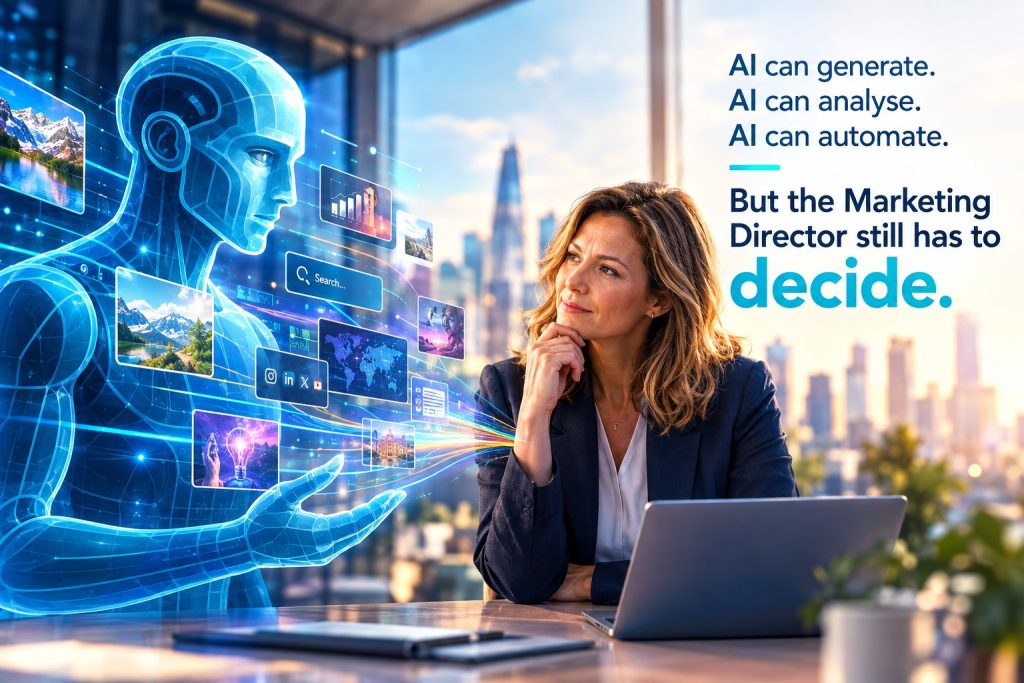
Why the future belongs to Marketing Directors who combine technology with human judgement
For more than three decades, the internet has transformed marketing. Websites, search engines, smartphones, e-commerce, social media, and cloud computing have fundamentally changed how organisations attract, serve, and retain customers.
Contents
Today, another transformation is underway.
Artificial intelligence is rapidly becoming part of everyday business life. It is writing copy, creating images, analysing data, recommending products, answering customer enquiries, and helping managers make decisions. Yet while the technology is changing rapidly, the purpose of marketing has not changed.
Marketing still exists to understand customers better than competitors, build distinctive brands, and generate sustainable, profitable growth, and create value.
The challenge for today’s Marketing Director is therefore not simply adopting AI, but understanding where technology creates advantage, where it creates risk, and where human judgement becomes more valuable than ever.
The more AI can do, the more valuable human judgement becomes.
AI has fundamental implications for what Marketing Directors spend their time doing — and what they should they become better at.
The first digital revolution is over
The first phase of digital marketing focused largely on new channels.
Organisations built websites, invested in search engine optimisation, embraced e-commerce, experimented with social media, and developed increasingly sophisticated digital campaigns. Marketing became faster, more measurable, and more accountable.
These technologies are no longer new. They are now simply part of business.
To lead marketing in a digital and AI world today the challenge is different. Rather than asking, “Which channels should we use?”, Marketing Directors increasingly need to ask:
- How should AI influence our decisions?
- How should data help optimise customer experiences?
- Which technologies genuinely improve competitiveness?
- Where should humans remain firmly in control?
These are leadership questions rather than technical ones.
AI changes the tools, not the purpose of marketing
Much of the discussion surrounding AI focuses on automation and efficiency.
While these benefits are real, they are only part of the story.
The greatest opportunity lies in improving the quality and speed of decision-making.
AI can identify patterns within large volumes of customer data that people may never notice. It can help marketing teams work more productively, generate alternative creative ideas, and pressure-test different scenarios. However, AI has no commercial judgement. It cannot fully understand organisational politics, people, long-term brand reputation, ethics, customer emotions, or strategic priorities. Those remain human responsibilities. Rather than replacing Marketing Directors and CMOs, AI is increasing the importance of leadership.
Technology evolves. Marketing evolves. Leadership matters most
The evolution of marketing leadership can be visualised simply:
Figure 1: The Evolution of Marketing Leadership
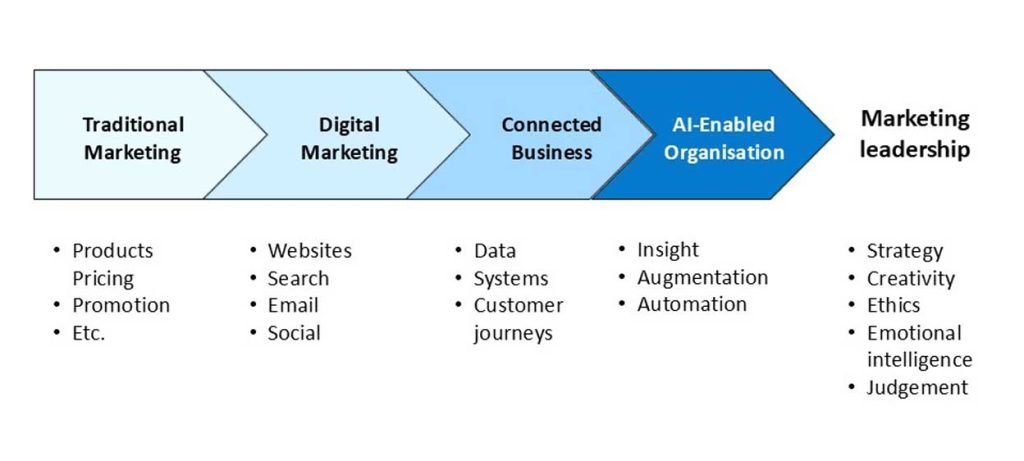
Each stage has expanded marketing’s capability. None has reduced the need for leadership. Indeed, the opposite is true. As technology becomes more powerful, organisations need stronger leadership to ensure it is applied responsibly, commercially and in ways that strengthen customer relationships.
Brand building has never been more important
One misconception is that AI will reduce the importance of brands. In reality, it is likely to increase it. As AI systems generate more content, products and recommendations, customers will increasingly seek organisations they know, recognise and trust. Brands communicate reliability, values, and expectations. They reduce uncertainty.
Creating a great customer experience has always been essential. The next challenge is creating distinctive customer experiences that customers remember, recommend and return to.
While technology can help deliver experiences, only organisations can create meaning.
Thus, marketing remains a people business
Perhaps the greatest surprise of the AI era is that emotional intelligence may become even more valuable.
As our recent FTSE 100 research found, Marketing Directors must increasingly work across organisational boundaries, and bring together sales, finance, operations, technology, and customer service in order to improve customer experiences.
Successful leaders build trust. They communicate clearly. They involve and inspire colleagues to solve problems rather than dictate solutions. Technology can accelerate decisions, but people determine whether to accept and implement or reject decisions and thus succeed or not.
Looking to the future
No-one knows precisely how marketing will evolve over the next decade. New platforms will emerge. Search behaviour will continue to change. AI capabilities will become increasingly sophisticated. Customer expectations will continue to rise.
Rather than trying to predict every development, successful Marketing Directors must develop what we describe as early warning radar—to continually scan the market, competitors, customers, and emerging technologies to identify opportunities and threats before others do.
So, remain curious. Challenge assumptions. Test new ideas while remaining grounded in sound marketing principles.
The organisations that succeed are unlikely to be those with the most technology. They will be those that combine technology with better judgement.
What AI cannot do – and what remains the role of the Marketing Director
As AI and digital technologies take on more of the technical and executional work of marketing, some distinctly human capabilities become more—not less—important.
AI doesn’t make all human skills more valuable. It makes particular human capabilities more important where the job is to decide, interpret, challenge, create meaning and influence people. So you need to:
1. Judge what is creatively good
The more AI can do, the more valuable human judgement becomes.
AI can generate huge volumes of copy, images, concepts and campaign ideas. However, generating possibilities isn’t the same as knowing which idea is distinctive, relevant to the customer and right for the brand.
The Marketing Director therefore needs to be able to brief creativity well, challenge it constructively and recognise genuinely strong creative work. Taste, judgement, imagination and the ability to make connections remain human responsibilities.
Your job is to decide:
- Is the idea genuinely distinctive?
- Is it relevant to the customer?
- Does it strengthen the brand?
- Will people notice and remember it?
- Is it commercially worthwhile?
- Is it appropriate for the organisation?
So don’t outsource your creative judgement to AI. But do use AI to increase the number of possibilities you consider — then apply human judgement to choose which is best.
2. Build brands that people actually value
AI can help analyse brand performance and create brand assets. It cannot, by itself, cannot determine the underlying reason why customers prefer a brand. Nor can it decide what a brand should stand for, why customers should care, or how a distinctive position should translate into the experience people actually value.
The marketing leader therefore still needs to understand customers deeply, make difficult choices about positioning and differentiation, and ensure that brand promise and customer experience reinforce one another.
That makes brand judgement a human leadership capability rather than simply another technical marketing task.
3. Understand customers beyond what the data says
AI will make organisations awash with more data, faster. But more data doesn’t automatically produce more insight.
New technology makes it easier to collect, analyse and act on customer data. But customer intent and historic data isn’t the same thing as understanding customer behaviour, and data doesn’t automatically explain why people choose, reject, trust or recommend something.
AI can tell you what customers did. Marketing Directors still need to work out why — and what it means.
So this requires curiosity and empathy: the ability to observe and get close to customers, interpret evidence, ask better questions, understand emotional as well as functional benefits, and recognise what the numbers may not be telling you.
It also requires commercial understanding and the willingness to challenge prevailing views.
And sometimes the most important insight will be something not yet contained in the data.
4. Know when to challenge the machine
The more easily AI can produce an answer, the more important it becomes to ask:
Is this actually right?
AI literacy isn’t the ability to use ChatGPT. It is the ability to know when not to believe it.
The modern Marketing Director needs enough understanding of AI to know:
- what it can and cannot reliably do
- what assumptions it is making
- whether the data or source material is sound
- whether the answer makes commercial sense
- whether it introduces brand, reputational, legal or customer risks
- when human review is essential.
Marketing leaders need to judge the quality, provenance, relevance and consequences of AI-generated output; challenge assumptions; recognise hallucination or bias; protect brand integrity and customer trust; and understand when human expertise must override the machine. So build machine and human stress-testing into your processes.
5. Influence people who do not report to you
If marketing expertise is increasingly distributed across the CEO, Board, customer, commercial, technology and other leadership roles, the Marketing Director cannot simply rely on organisational ownership of marketing to provide influence.
You have to earn it.
You need to explain, influence, manage and lead — our seven essentials — and translate customer and marketing insight into language that the CFO, CIO, CEO, sales leader and Board can act upon.
That means building trust across functions, resolving competing priorities and persuading people who do not report to you.
The Marketing Director increasingly needs to influence the CFO on investment, the CIO on technology, the sales director on customers, the CEO on growth and the Board on risk and opportunity.
That means being able to explain complex things simply, understand other people’s priorities and make a compelling commercial case.
AI can give you information. It cannot build the trust required to persuade the Board to act on it.
6. Decide what matters
Moving forward, Marketing Directors will have more possibilities, more channels, more content, more data, more automation and more AI-generated recommendations than ever before.
The scarce resource becomes attention and prioritisation.
So, to lead marketing in a digital and AI world, the Marketing Director’s job is increasingly to decide what not to do as well as what to do.
- Which customers matter most?
- Which opportunities deserve investment?
- Which data is useful?
- Which AI applications are worth implementing?
- Which channels are distractions?
- Which brand initiatives strengthen the proposition?
- Which projects should stop?
The Marketing Director’s New Advantage
AI will make many marketing tasks faster, cheaper and easier. That doesn’t make the Marketing Director less important. It changes what they are expected to contribute.
The paradox of AI is that as machines become better at doing marketing tasks, human judgement becomes more important in deciding what should be done, and how it should be done.
Competitive advantage will increasingly come from the ability to interpret rather than simply analyse; judge rather than simply generate; understand people rather than simply track behaviour; build brands rather than simply produce content; and influence the organisation rather than simply manage the marketing function.
The future Marketing Director therefore needs to be neither an AI technologist nor a traditional brand manager. They need to be a commercially minded business leader who can combine customer understanding, creativity, brand judgement, data, technology and human influence.
In other words, the Marketing Director’s value is moving further upstream — from doing marketing to deciding what marketing should do, why it should do it and how it should create value for customers and the business.
A practical guide for today’s Marketing Director
The latest edition of The Marketing Director’s Handbook is an in-depth guide to lead marketing in digital and AI world.
Volume 3 – Leading Marketing in a Digital and AI World examines how AI, digital transformation, data, platforms, governance, and leadership are reshaping the Marketing Director’s role. It will help you ask better questions, shape better strategies, and influence and lead wisely across your organisation. It is out now.
For readers seeking a comprehensive marketing guide, our new combined Volumes 1 & 3 edition brings together the enduring principles of marketing strategy and leadership with the latest thinking on digital marketing and artificial intelligence.
Whether you are an experienced Marketing Director, an aspiring CMO, a business leader or a senior marketer preparing for your next role, the fundamentals remain the same.
Technology will continue to evolve.
Marketing will continue to evolve.
The need for thoughtful, commercially-minded marketing leadership has never been greater. So, the future is yours to influence and shape.


