



New research by The Marketing Directors to accompany the publication of the latest edition of The Marketing Directors’ Handbook finds that 70% of FTSE 100 companies have meaningful marketing, customer or brand expertise at Board or senior-management level. Within the FTSE 100 companies:
- 0% have a conventional Marketing Director on the main PLC Board
- 11% have a CEO with substantial marketing/customer expertise
- 45% FTSE 100 Boards have substantial marketing expertise beyond the CEO
- 30% have a marketing leader beyond the Board i.e. on the senior management teams
- 38% have additional substantial marketing expertise on the senior management team
- So overall 70% have marketing expertise at Board or senior-management level
Background and Research Objectives
Contents
In 2007, Professor Malcolm McDonald conducted research that concluded that just 14 FTSE 100 companies had marketing directors on their Boards. This was widely commented on and perceived at the time to diminish the role and influence of marketing as a profession. We commented on this in Volume 1 of The Marketing Director’s Handbook. So we’ve now researched Britain’s FTSE 100 companies, to answer the question today: where does marketing expertise sit within the leadership of the business, and how far does it influence corporate decision-making?
Six Headline Findings
1. Marketing expertise is everywhere — but the traditional Board Marketing Director has disappeared
The strongest finding from the research is that 70 of the 100 FTSE companies have meaningful marketing, customer or brand expertise either at PLC Board or senior-management level.
The research identifies three overlapping forms of senior marketing influence:
- marketing/customer experience within the PLC Board;
- a senior executive whose principal role is marketing or an equivalent substantial marketing function;
- other senior executives with meaningful marketing, customer or brand expertise.
The picture is that marketing capability is not necessarily concentrated in a single “Marketing Director” but can be distributed between the CEO, Board, Chief Marketing Officer/Chief Customer Officer/Chief Growth Officer and other senior commercial or business leaders.
2. Zero Marketing Directors sit on FTSE 100 PLC Boards
Our analysis identifies 0 of 100 current FTSE 100 companies with a Marketing Director, CMO or equivalent whose formal role places them on the main PLC Board. This contrasts with the 14/100 reported by Professor Malcolm McDonald’s in 2007 (1).
The comparison is striking — and raises the question — why?
The answer lies partly in how corporate leadership has changed.
The statutory Board is no longer a complete map of corporate influence.
The marketing leadership function has not disappeared; it has increasingly moved into broader executive and commercial roles.
3. Marketing experience reaches the CEO
Our research identifies 11 CEOs with substantial marketing, consumer, customer or marketing-led commercial backgrounds.
Some modern CEOs started in marketing, brand, customer or commercial roles and subsequently accumulated broader operational and financial responsibilities. Marketing expertise has therefore become part of a broader general-management skillset.
The routes are diverse. At Tesco, CEO Ken Murphy’s career includes substantial commercial, marketing and brand experience, including global product brand management. Reckitt’s, CEO Kris Licht previously served as President, Health and Chief Customer Officer. At Burberry, CEO Joshua Schulman’s career spans senior brand, merchandising, luxury retail and chief executive roles.
This is significant because it demonstrates that marketing expertise can be a career route to general management and ultimately the chief executive role.
4. Customer-led businesses are the strongest adopters of marketing leadership
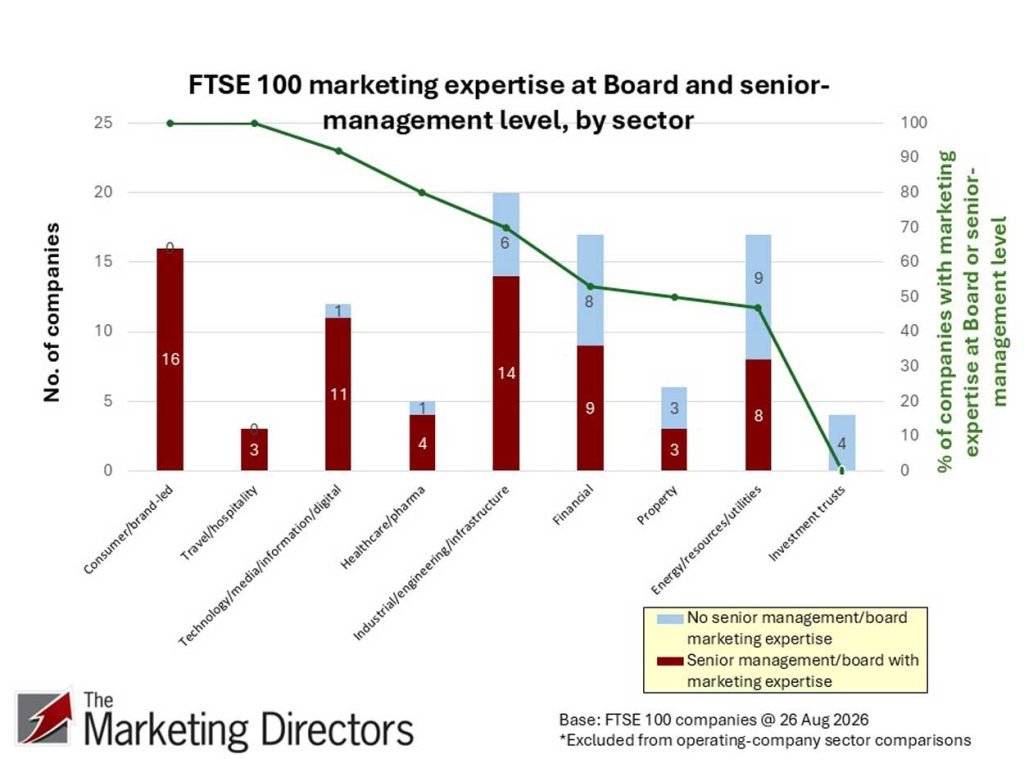
The sector analysis is perhaps the strongest corroborating evidence for the overall finding.
The FTSE100 comprises 16 companies classified as consumer/brand-led. 16 (100%) have senior-management marketing/customer expertise; 15 (94%) have Board-level marketing/customer expertise; and 100% have expertise at one or other level. This is an unusually strong concentration.
The result is intuitively credible: in businesses where brands, consumer choice, customer experience, loyalty, pricing, product proposition and competitive differentiation are fundamental business drivers, marketing capability is much more significantly represented within senior leadership.
The travel/hospitality and technology/media/information/digital sectors show a similarly high incidence of senior-management expertise.
At the other end of the spectrum, the incidence is substantially lower in sectors such as energy/resources and financial services.
Marketing leadership is most deeply embedded where customers, brands and competitive differentiation are most central to the business model.
Figure 1: FTSE 100 marketing expertise at Board and senior management level, by sector
5. The Marketing Director is becoming a broader business leader
Our research also identifies over 30 more senior-management marketing leaders operating outside of the Board.
Some have familiar titles: Chief Marketing Officer, Marketing Director, and Chief Customer & Marketing Officer.
Others operate under broader titles incorporating: customer, commercial, growth, data, markets, technology and corporate affairs.
At Sainsbury’s, Mark Given combines technology, marketing and data leadership on the Operating Board. Also at Aviva, Cheryl Toner combines customer and marketing leadership at Group Executive Committee level. While at IHG, the Chief Commercial & Marketing Officer sits on the Executive Committee.
This reveals the changing nature of the discipline. Marketing appears increasingly embedded in broader commercial and customer leadership rather than always operating as a discrete or siloed corporate function.
6. Why has the traditional Board Marketing Director disappeared?
There is no single explanation, and our research does not establish a direct causal link. However, the structure and responsibilities of corporate leadership have changed substantially since 2007.
Boards and management have become more clearly differentiated
The UK Corporate Governance Code now distinguishes the Board’s governance and oversight responsibilities from the management of the business. The FRC’s current guidance emphasises that Boards should determine matters reserved to them while obtaining the information, expertise and advice needed to make effective decisions. The 2024 Code applies from financial years beginning 1 January 2025, with the new Provision 29 applying from 1 January 2026.
Thus a senior executive does not need to be a statutory director to have substantial influence over corporate strategy and performance.
Executive leadership has become an important layer between the Board and the business
Our research found a recognisable Executive, Management or Operating Board — or equivalent — in 86% of companies.
This is where many of today’s senior functional leaders sit.
A CMO, Chief Customer Officer or Chief Growth Officer can therefore have significant responsibility for strategy, investment, customer experience, brand and commercial performance without being a statutory director of the PLC.
The Board’s responsibilities have also broadened
Under Section 172 of the Companies Act 2006, directors must promote the success of the company while having regard to, among other things, long-term consequences, relationships with customers and suppliers, and the company’s reputation.
This means that issues traditionally associated with marketing — customers, relationships, reputation and long-term value — sit within the wider context of Board decision-making.
Thus, there is no requirement per se to give marketing a statutory role on the Board.
Reporting and governance have become more explicit
Large companies have also had to explain, through Section 172 reporting, how directors consider these factors in their decision-making.
Taken together, these developments help explain why the absence of a specialist Marketing Director from the statutory Board does not necessarily indicate the absence of marketing influence.
Conclusions
The traditional Board Marketing Director may have disappeared, but marketing itself has not. What appears to have changed is where marketing expertise sits — increasingly distributed across CEOs, PLC Boards and senior executive management.
In 2007, the presence of a Marketing Director on the PLC Board was an important indicator of marketing’s corporate standing. In 2026, that single measure tells only part of the story.
The evidence suggests that marketing has evolved from a discrete corporate function into a more widely distributed business capability.
The challenge for today’s Marketing Director is therefore not simply to gain a seat at the table, but to demonstrate the customer, commercial, technological and strategic capability to influence the decisions being made around it.
“Three decades ago, marketing was often viewed primarily as a creative or promotional department, and its contribution to business value was frequently misunderstood and under-appreciated. Our experience is that increasing competition and digital disruption have changed that. As markets and products become more commoditised, the ability to understand customer intent, use data and technology intelligently, build distinctive customer experiences and drive growth has made marketing capability increasingly important at executive level.”
“The modern Marketing Director is no longer simply a brand steward. They need to be a commercially minded business leader who can connect customer understanding, marketing expertise, technology and data to business performance.”
Guy Tomlinson, co-author of The Marketing Director’s Handbook
“There is a growing body of research into the relationship between marketing experience at Board level and business performance. We would expect the influence of marketing expertise to extend further as businesses and sectors become more competitive.”
“That is particularly relevant in B2B markets, where marketing has sometimes been less prominent than in consumer-facing businesses. Companies operating with strong sales functions, for example, can add significant value by bringing marketing skills into the wider commercial organisation — developing a deeper understanding of customer needs, markets and demand rather than relying on sales activity alone.”
Tim Arnold, co-author of The Marketing Director’s Handbook
Reference
- McDonald, M. Professor (2007) Marketing on the Boards of FTSE Companies (researched using Companies House information), Cranfield School of Management (variously cited, though no longer available online)
Further information
The numbers behind the findings (PDF download)
The 2026 FTSE 100 results, definitions and headline comparisons.
Research methodology and evidence (PDF download)
How companies were classified, sources used, limitations and historical methodology
Download the full 2026 FTSE 100 Marketing Leadership Benchmark (PDF)
Full research, numbers and methods on the changing influence of marketing in Britain’s largest companies
If you have questions on our methodology or findings just get in touch.


